
Candidate’s Handbook
Earth Alchemy
Part II
Step Five of the Alchemist’s Curriculum:
Concentration
In your chosen posture gently and consistently train your mind to one-pointedness. The mind should be empty of contents. Practice a moderate length of time each day, not forcing it to the point of rigidity, but certainly working past many discomforts and disappointments.
Sitting in your posture with right hand in left, the tips of the thumbs touching, keeping the spine erect and eyes forward, breathe naturally and allow yourself to relax. Imagine a sphere of light encircling your body. This sphere not only acts to purify your entire being, it also is a shield to protect you from all negative energy.
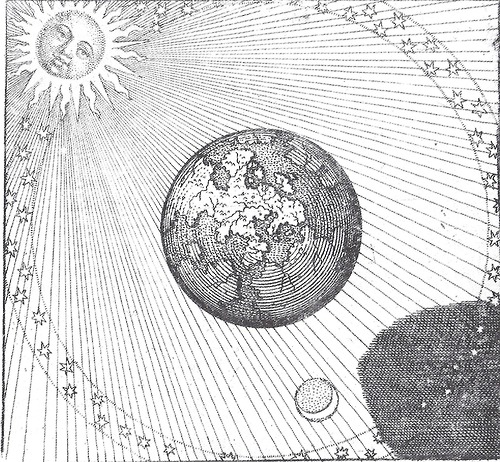
Feel earth below you, heaven above, and your human being in the center. The alchemical Moon, Sun and Mercury, respectively, are mere symbols of the three elements directly observed through this simple method of concentration.
Focus on your center of gravity, about fifty mm (two inches) below the navel for men, seventy-five mm (three inches) for women. This location is your ‘One-Point,’ and may be thought of as the gate to no-mind. It is the center of balance of a man, where a woman’s is a bit lower due to her hips. Imagine light or energy extending in all directions from that point. This is the point to return to whenever you need to ground yourself.
Other points of focus may include such targets as a candle flame, the tip of the nose, or any of the Seven Seals as they are imagined along the spine of the body. In fact, every rite of the Royal Art Society requires this method of concentration, which is cultivated by doing the rites.
The Fourth Microcosmic Function: Willpower
One important aspect of being healthy is a comfortable and effective self esteem. When self esteem grows too high, one becomes absorbed in vanity or arrogance, losing sight of one’s other faculties, and is thereby weakened. When one’s self esteem is too low, one is ineffective and unable to feel content.
In order for the human being to work at its optimum level, each function of the human must work at its optimum level. In order for each function to work at its optimum level, there may be no imbalance of strength. Any function which excels above the rest steals energy that is needed by the other functions, and any deficiency of strength within any function weakens and imbalances the whole human.
It is convenient to analyze self esteem in terms of self concept. The first type of self concept is bound to fail, this idea is that one is a failure and success is caused by outside forces. The second self concept sees success as a probability based on one’s personal merit, and any failure is seen as an obstacle to be overcome.
Only the second self concept is effective in making achievements. The alchemist shall be included in activities which aim to increase confidence and hence ability. The difference between one who succeeds and one who generally fails is the self-concept. Different types of self-concepts are:
- “I usually fail, if I succeed, it is not my doing”
- “I usually succeed, if I fail, I must figure out why and change it.”
- “I need to depend on others (the teacher) to guide me”
- “I am self-directed, dependent only on an inner teacher, able to distinguish between the true and false, wrong and right.”
The alchemist must have a clear idea about each of these different self-concepts. One should compare the models and note how each one differs from its opposite and answer the questions “How can I change? What differences in attitude may I make to become the positive personality? What aspects of my being could use some strengthening?”
It is important how one faces obstacles. Obstacles are challenges to be met, they are forks in the road where one path leads to death or ruin, one to accomplishment and growth. Obstacles may block our flow of creativity; or they may push us to greater levels of talent and ability. As it is said: “no pain, no gain!” and “never give up!”
Once one has created a model consisting of the qualities one wishes to develop, the alchemist will chart his or her success in acquiring these qualities. When an alchemist is able to observe his or her own improvement on paper, such as in the form of completed goals, the alchemist has motivation for higher achievements. Self esteem is the psychological expression of the will. The will of the alchemist is an important aspect to train.
The alchemist will learn how to focus the will, how to strengthen the will, and how to revitalize the will after it seems to be depleted. A strong and healthy will is necessary to the refinement of consciousness. The direction of the will must be steady if one is to make great achievements. The will must be mastered.
One must understand when to relax the will, when to use patience and gentle influence, when to advance with full strength, and when to feed the will. When one does not know the correct use of the will, situations are left up to chance.
The Royal Art Society alchemical process includes techniques for discovering and isolating the faculty of will, and the proper methods for directing the will to use it to its fullest extent. The personal will must come into harmony with the will of the cosmos. That is, the alchemist must learn to follow his or her natural, true path in life. When one shares one will with the universe, one is free of all contention. The practices and rites of the Royal Art Society support this process.
Step Six of the Alchemist’s Curriculum:
Health and Deep Healing; The Return to Tranquility Exercise
While a painful or malevolent experience is occurring, when one gets angry or afraid, one can regain one’s calm by simple breathing and stillness. Basic side to side or up and down movements of the waist and arms helps calm some people. For comfort the alchemist can imagine the purified Microcosm in the center of one’s head, or visualize oneself as the Cosmic Human in silent meditation.
An example of this is the Immortal Emperor or Empress meditation of the Elixir of the All-Seeing Eye of the Royal Art Society: Rite of the Immortal Empire, Inner Temple and Holy Throne.
Chronic emotional pain requires deep healing. Deep healing may begin with a preliminary meditation for relaxation for fifteen to twenty minutes. At the first rising of any emotion one can first quietly observe the breath. Calm down by taking a few deep breaths. When the breath has been calmed and silenced, observe thoughts, emotions and feelings. Let these distractions flow by as they do naturally.
Doing the relaxation exercise, mentally scan for pain and release it, observing your anatomy. Feel healing, visualize healing, and be positive! This positive energy is life-force. Probe your memory of the past for painful or malevolent experiences. Release them all. Forgive completely. This is a way to homeostasis and inner peace.
Heal emotionally. Connect with the source of life, one’s ‘Original Self’ or ‘True Nature.’ Connect with nature. Connect with people. Let negative feelings flow. Go with the flow. Do not fear or deny them, but express them with the positive intent to heal.
Replace negative feelings and thoughts with a positive attitude by clearing out the negative. Then use your willpower to gather to your center the positive forces of the cosmos, like the energy of the natural elements from the earth, water, the sun and the air, and the vastness of space.
Use this positive energy as a healing prayer for yourself, your family and loved ones, your local community, your province, your nation, the Royal Art Society, the whole earth and Cosmos. Always bring your awareness back to your body at the end of the exercise with a few deep breaths, blinks of the eyes, and gentle body and limb movements and stretches.
The Fifth Microcosmic Function: Emotions
The alchemist will study the way of governing and healing his own emotions. When one’s desires are great, one is either frustrated by lack of fulfillment, or manipulated by one’s own designs. Great desires control a person, while a great person controls desires. The same may be said of the intellect and of emotion. How may one guide one’s own destiny if one is subject to the blind force of desire?
When the will is concentrated on fulfilling desires, a being’s mind is unfocused and easily manipulated by external forces. The regulation of one’s own desire strengthens the will. It opens the mind to new experiences of joy that put most experiences of sensual pleasure to shame. Circumscribing one’s passions thus is essential to the alchemical process.
Moderate desires and sensual pleasures are necessary to well-being. One may experience the utmost joy by one’s own effort. This joy is inherent within the human being, but is replaced by myriad desires and knowledge. Pleasure is not inherent, but is something acquired by the human being. The regulation of desire for the experience of inner joy is the proper choice of attaining lasting happiness, for what is inherent may be veiled, but never lost, whereas anything which is acquired may be taken away forever.
The same concept applies to the idea of rediscovering innate knowledge and subjugating acquired knowledge. The alchemist learns how to unveil true innate joy and how to maintain it. Methods of self discipline are offered to the alchemist who is ready to sacrifice chasing temporal pleasures for a period in order to find true joy.
Desire may be defined as any bias, or any prejudice pertaining to external conditions. When one desires, one creates for oneself great limitations in the form of emotional dependency upon uncontrollable external movements. For the period of time in which one’s desire is fulfilled, one is pacified for the most part by a positive or pleasurable emotional response.
However, when the time comes for one’s desires to be unfulfilled, one is forced into negative emotion, or anger. The individual who lives by the cycle of extreme positive and negative emotion also experiences times of dullness between the times of extreme emotion.
An analogy may assist in producing a visual understanding of emotion. Negative emotion is comparable to the experience of black, positive emotion corresponds with the experience of white, and the empty, emotionless state is comparable to the balance of the extremes: gray. By regulating desire, at first one’s emotional color will change from the energy draining fluctuations of black and white to the energy draining stagnation of gray.
This neutral, emotionless state is by no means the goal or the end of the regulation of desire. Within the tranquility and calm of the gray there abides a hidden jewel, or stone, so to speak, of consciousness. This consciousness may only be reached through the final dissolution of emotion and desire. This is the state of joy mentioned above. This joy, it may be mentioned, is the final stage before the realization of pure consciousness.
The Sixth Microcosmic Function:
Consciousness- Return to Original Nature
“Concentrating your qi to become soft,
Can you become like a newborn infant?”
– Laozi, Chapter Ten
When a human is first born, it has just begun to experience, the mind has not yet formed cause‑ effect associations. In other words, the infant has no reason to believe that the world it is in follows any laws, or any order. Reality is not stable. Yet the nature of the mind is such that after only a few repetitions of a cause‑ effect relationship, that association is realized by the mind, and the mind is no longer free to experience the moment in pure awareness.
When the mind begins to make associations, which are important to survival, or wisdom, it also picks up an unfortunate load of “extra baggage,” which is called expectation. When a familiar action is observed or emitted by the child, he expects a familiar effect or response. Expectation has a large hand in forming one’s reality. If one expects to fail, there is a greater chance of failure than if one had the confidence of success. This new way of organizing the world has further disadvantages for the beginning human. Pure consciousness observes itself, outside of cause and effect, outside of time.
In order to clearly understand the human being, it is necessary to refer back to the infant, to reduce the complex tangle of diverse functions of the adult into a simple and intelligible model. This model must represent the beginnings of each human, so no matter how complicated an individual may seem, the alchemist shall be able to organize the information about the individual into a comprehensive and workable model.
The twelve organ microcosmic alchemical anatomy is one such model. Hence, it is reasonable to consider the human’s natural state long before it takes its first breath, indeed, before it has experienced. For the sake of utmost simplicity on a subject of utmost difficulty, we shall adopt the point‑ of‑ view of the infant and assume that this human is the only human in existence.
The first experience one is able to imagine is that original experience of self. Far before the infant exits the womb, it experiences itself. This original experience is the initial separation from “oneness,” the first discrimination in the mind. To explain, once the universe became conscious of itself through a living organism, the first imagined division within the universe occurred, that is, self and not‑ self. ‘Self’ may be defined only by some thing other than self, and the simplest generalization to define ‘self’ is ‘not‑ self.’
So here is a universe that has ceased to simply be; it has become. It has become a one (1), as opposed to a zero (0); it has become a self (along with a not‑self); it has acquired an idea of being, distinct from the idea of nonbeing. This entity knows only, “I am.” It is from this entity that all more complex creatures evolve. This being is the first cause of all consequent ideas, or internal worlds. It is the quintessence or “spirit” of the only energy which names and defines, that is, life, and more specifically, the human or Homo sapiens. This is the original state of every human being.
Step Seven of the Alchemist’s Curriculum: Visualization
& The Seventh Microcosmic Function: Imagination
The reception of images marks the next experience after the original state of Homo sapiens. Images, or further illusionary distinctions between things, appear to the consciousness, breaking up the generalizations of self and not-self. Probably the second discrimination is between bliss and not-bliss.
It is important to remember that the human’s internal world is being subject to analysis at this point in its life. That is, pure consciousness is making way for the myriad distinctions of the imagination. However, as the internal world changes, the external world remains the same. The external world and the internal world were the same before consciousness produced an idea of itself distinct from the whole.
The constant movements of the external world are ignored, blocked out and gradually forgotten by the separate ego, which eventually falls out of harmony with these dynamic changes. This digression is almost inevitable considering the alluring and overwhelming quality of the images of the internal world created by perception and the imagination.
One goal of rites of the Royal Art Society is to realign the ego with the subtle movements of nature by making the alchemist aware of them. This is where the science of the Royal Art begins, the three stages of internal alchemy and the four elements; where our imagination divides the Cosmos into opposites, a third mediating force, and four physical elements.