
Candidate’s Handbook
Earth Alchemy
Part III
The Three Stages of the Alchemical Process
There is no single alchemical process used universally among alchemists. The Emerald Tablet of Hermes offers no specific procedure. Western alchemical works from the Renaissance onward describe processes of three, five, seven, nine, twelve or more stages, in varying order and called by different names. Chinese alchemical descriptions are even more diverse. The Western seven-fold process based on the planets, metals and corresponding gods is a prime example of a traditional and widely known alchemical process.
Alchemy is the union of macrocosm and microcosm. The alchemist of the Royal Art Society prepares for the Chymical Wedding with a lifestyle of purification, a holistic education, cultivation of the Twleve Functions of the microcosmic anatomy and meditation of the Elixir of the Seven Seals. The Chymical Wedding, itself, climaxes in the “embracing the One” or no-mind meditation, the true Stone of the Philosophers.
Complimentary to the seven seals is a circuit of twelve meditations. These twelve meditations consist of three cycles of death and rebirth: the Cycle of Earth (moon, salt, nigredo), the Human Cycle (mercury, Mercury, albedo) and the Cycle of Heaven (sun, sulfur, citrinitas, rubedo). These three cycles are, for the inner alchemist, divided into twelve meditations as demonstrated below.
The first four of the seven meditations correspond with the first four of the seven seals of inner alchemy. These are Calcination, Dissolution, Separation and Conjunction. Conjunction consummates in the Chymical Wedding and the birth of the inner guide, the voice of the true self or True Will, also known as the Eye of the Cosmos, “All-Seeing Eye,” Primordial Human, and Spiritual Fetus.
If further steps seem superfluous, it should be remembered that all alchemical meditation is meant to expedite the mystical communion of the Philosopher’s Stone, and all visualization is ultimately unessential to that end. The point of internal alchemy is to lead the practitioner to the proper conditions for mindfulness meditation.
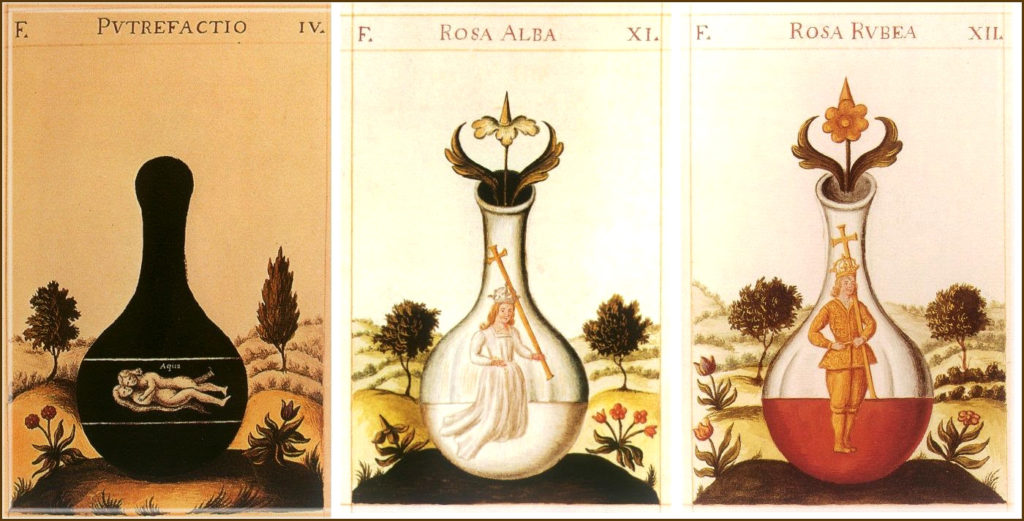
The next two stages are each divided into two steps. Fermentation is divided into 1.) the putrefaction of the recipe, the death of the inner guide and 2.) its resurrection in a new, mature form. The result is termed “enlightenment” or “illumination,” the temporary realization of pure consciousness and cosmic oneness.
Distillation is divided into 1.) boiling the ferment to produce evaporation; then 2.) boiling the condensation in a separate receiver to further increase the purity of the elixir. This is the sustained or permanent calming of the mind to simply observe with pure consciousness without distraction from either thoughts or feelings.
The final stage, Coagulation, encompasses the whole three-fold formula, with the addition of a fourth stage for good measure: nigredo, albedo, citrinitas and rubedo. Citrinitas is the yellow stage wherein lunar silver is transmuted into solar gold. It is the lucid ego transforming into a self-actualized whole, just previous to rubedo, the final stage of redness or true gold, and the end of the Great Work.
Prima Materia: the First Matter
Alchemy, like science, has its own cosmology. The best alchemy accords with science and the best science accords with the ends of alchemy. Alchemical cosmology begins with First Matter and divides into cosmic opposites, which combine to create a trinity. All of which lays the foundation of the macroscopic universe and the alchemist’s own life and development.
Alchemy is the answer to theology and metaphysics. It is the root and organized blueprint underlying chemistry, physics, astronomy, medicine and the other branches of science, with which the alchemist remains well acquainted.
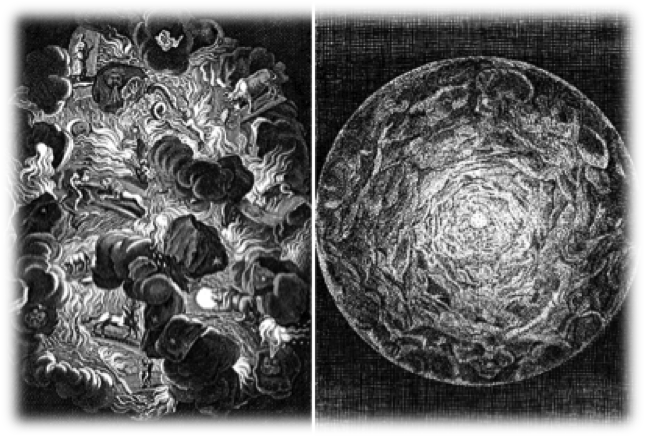
The Latin Prima Materia, or First Matter, is the primitive and formless Chaos, the base of matter, out of which all other matter took form. The First Matter is separated into the opposites, the gross matter and the pure soul or awareness, symbolized by the moon and the sun, respectively.
The Moon and Sun of The Emerald Table of Hermes Trismegistus, the short cornerstone text of Western alchemy, is the yin and yang of Chinese philosophy; the cosmic opposites. Macrocosm and microcosm were described by the Greek Neoplatonists as the opposites in the world order.
These ultimate opposites are the cosmos and the individual human being, united and defined by the golden ratio; a + b/a = a/b or “as above, so below.” The golden ratio exists between macrocosm and microcosm when the observer reflects the observed. In the feedback the opposites are united as One. This One is void (0).
The British Peter Atkins, born 1940, former professor of Chemistry at the University of Oxford, said in his book On Being[1], that existence rested upon a foundation of nothing. The universe is in balance insomuch as its total electrical charge equals zero. Nothingness divided into equal and opposite electrical charges. This does not say that something came from nothing, rather, that charge exists eternally out of necessity and is separated within itself. Separation produces positive and negative charge, the physical forces and chemical elements, and the very fabric of space-time.
This is reminiscent of ancient Hermetic teachings and of ancient Chinese philosophy, especially the Daoist and yin-yang schools. The Daoist school advances the theory of the Dao or Way, describing it as the origin of all things, and asserting that humans can become immortal by returning to it. The Way is empty, deep and still as an abyss. It is eternal and may be used infinitely to moderate extremes, bring tranquility and nurture qi or life-force.
Laozi’s Daoism is a natural humanistic philosophy possessing many elements shared by the philosophies of secular humanists, who promote science as the theory and practice of discovering the underlying laws of nature.
The Binary and Sacred Geometry
The oldest book of Chinese wisdom, the Yijing, or Classic of Change, is founded upon the yin- yang theory. The Yijing relates a philosophy of predictable absolute reality based on the universal cyclic behavior of yin and yang energies. Yin and yang can symbolize, as the two fundamental polar elements of reality, the positive and negative charges at the foundation of the existence of all energy and matter.
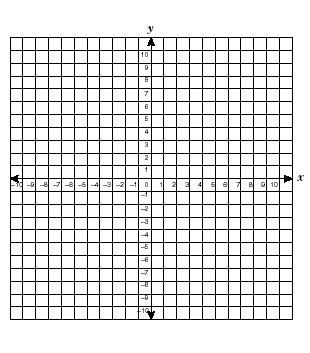
The yin and yang together in the familiar symbol are called taijitu. The cosmic opposites may signify the ones and zeros of the binary numeral system. They may also represent the positive and negative values of Algebra, where Wuji, naught, is the “origin” or zero at the center of the algebraic graph of space and time. The algebraic graph is a tool used to mathematically explain rules of existence and change within the dimensions of space and time. To the alchemist yin and yang can indicate the opposites, macrocosm and microcosm.
“Geometry existed before the Creation. It is co-eternal with the mind of God… Geometry provided God with a model for the Creation… Geometry is God Himself.” Thus said Johannes Kepler, Harmonice Mundi, The Harmony of the World (1619), book IV, Ch. 1, in a translation from Carl Sagan’s Cosmos.[2]
This quote from one of the world’s greatest scientists reflects a Masonic understanding of the symbol ‘G,’ found in every lodge above the Worshipful Master’s chair, and sometimes between the square and compasses, the official logo of Freemasonry.
Many are of the opinion that the Grand Architect is not an anthropomorphic god, but simply natural law and man’s own internal world-view. Though this is the simpler explanation, these are much more abstract and difficult concepts to grasp, which is proper to nature no less than to the Ineffable.
If mathematics is the model of the Cosmos, then the formless essence of the creative force is the zero (0), or nothing, the ‘origin,’ at the center of the algebraic graph, a cross. To the Kabbalists it is ‘Ein,’ to the Daoists it is ‘Wu.’ Freemasons begin and end here in their study of the Liberal Arts and Sciences. The first chapter of the Laozi points to it:
As for the Way, the Way that can be spoken of is not the constant, eternal Way.
As for names, the name that can be named is not a constant, eternal name.
The nameless is at the beginning of all things in the universe and on the earth.
Once named, it is the origin or “Mother” of these myriad things.
Constantly without desires, one realizes the mystery and perceives its subtlety.
Constantly with desires, one sees only those manifestations
which one desires and seeks.
The Eternal and its manifestations together emerge from one Source.
These are two and yet they are One.
The Chymical Wedding:
Moon, Sun & Mercury as Salt, Sulfur & Mercury;
Transmutation in Three Phases: Black, White & Red
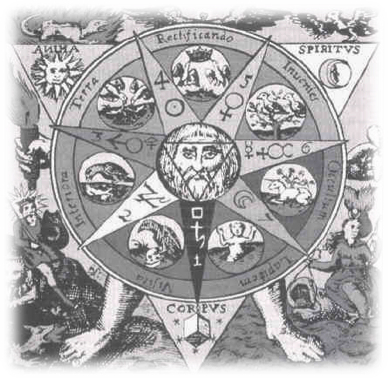
Pictured above is an emblem used by some Western alchemists for contemplation first published in 1659 in the book Azoth of the Philosophers by the German alchemist Basil Valentine. AZOTH is another name for First Matter. The ‘A’ and the ‘Z’ are traditionally associated with Alpha and Omega, the Greek symbols meaning the first and the last. Thus, the word Azoth is a hieroglyph encompassing everything, from the original state of Chaos in the beginning of the Cosmos and the Great Work, to the completed Philosopher’s Stone.
The illustration shows the head of the microcosm surrounded by the seven traditional processes of Western inner alchemy and the seven planetary seals. In the four corners are represented the four elements. A triangle about the microcosm depicts the masculine power of father and king, Sol (sulfur); the feminine virtue of the mother and queen, Luna (salt); and their child, the perfect cube, Mercury. To the left and right of the microcosm are also situated the lion and the fish, further symbols of the alchemical opposites to be married in the Chymical Wedding.
Thus the Prima Materia, or First Matter, the primitive and formless Chaos, separated into the opposites, which are joined in the Chymical Wedding to conceive new life. Gross matter, symbolized by the feminine moon and salt; and pure awareness, symbolized by the masculine sun and sulfur, Solve et Coagula, dissolve and coagulate, or separate and join, to produce Mercury.
In traditional Western alchemy there are three phases of the alchemical ascent that correspond with the three forces. The first stage of the transmutation of base matter into gold is Nigredo, the black phase, the dark primeval beginning, and is associated with salt and Luna, the passive, feminine principle. This first operation of the Great Work is sometimes symbolized by fire, the furnace, the crucible and the skull.
The Black Phase is followed by the albedo or White Phase, during Distillation. Albedo is the central whitening phase, purification, and is related to sulfur and Sol, the active, masculine principle. The end of the process is the rubedo or Red Phase in Coagulation, climaxing with the creation of the Philosopher’s Stone and the production of allegorical gold.
Rubedo, the final stage, is the Chymical Wedding, the Black and the White conjoined to create quicksilver or Mercury, the balancing principle, the Spiritual Child or Ultima Materia, the True Self, pure gold. These three phases occur in self-perpetuating cycles that may last moments, minutes, hours, days, years or decades.
In Western alchemy, the three forces need to be perpetually balanced within each of the seven planetary seals of the microcosm.
Yogic and Daoist Visualizations
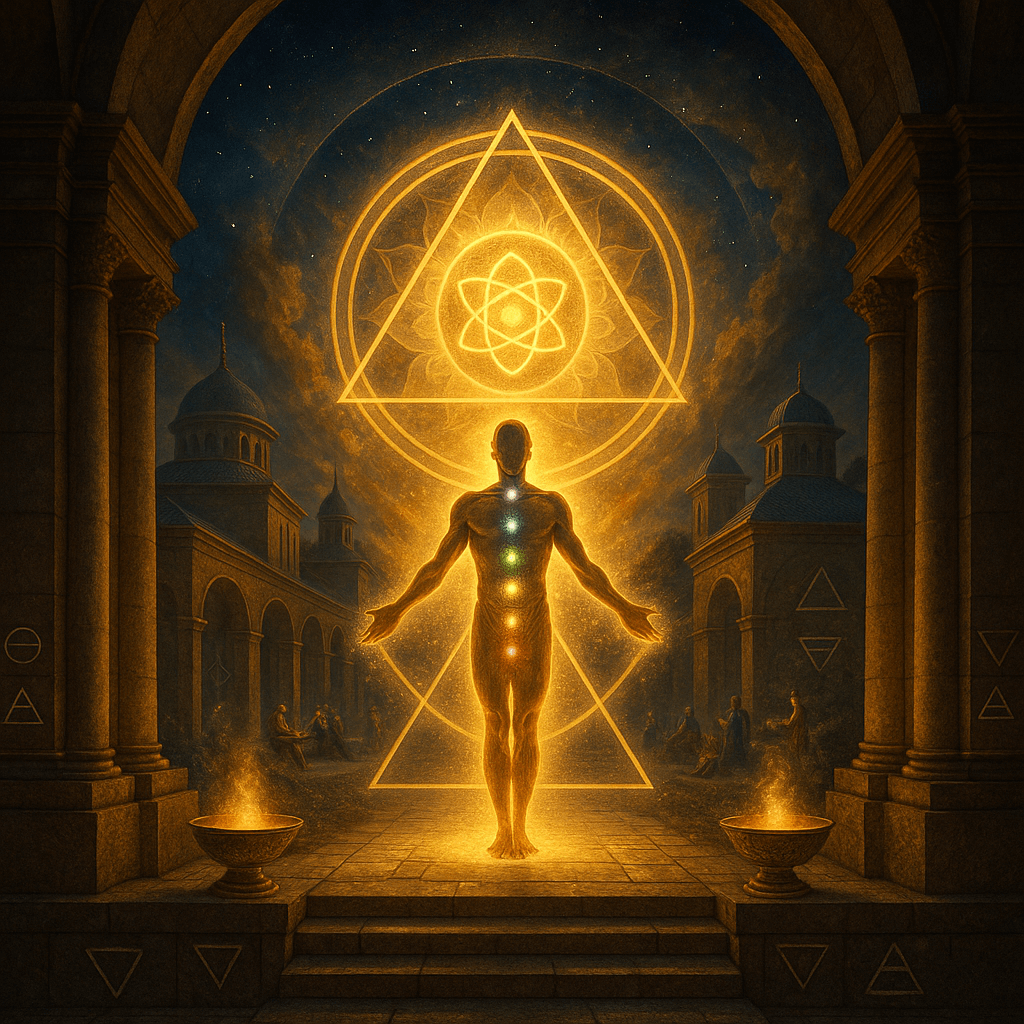
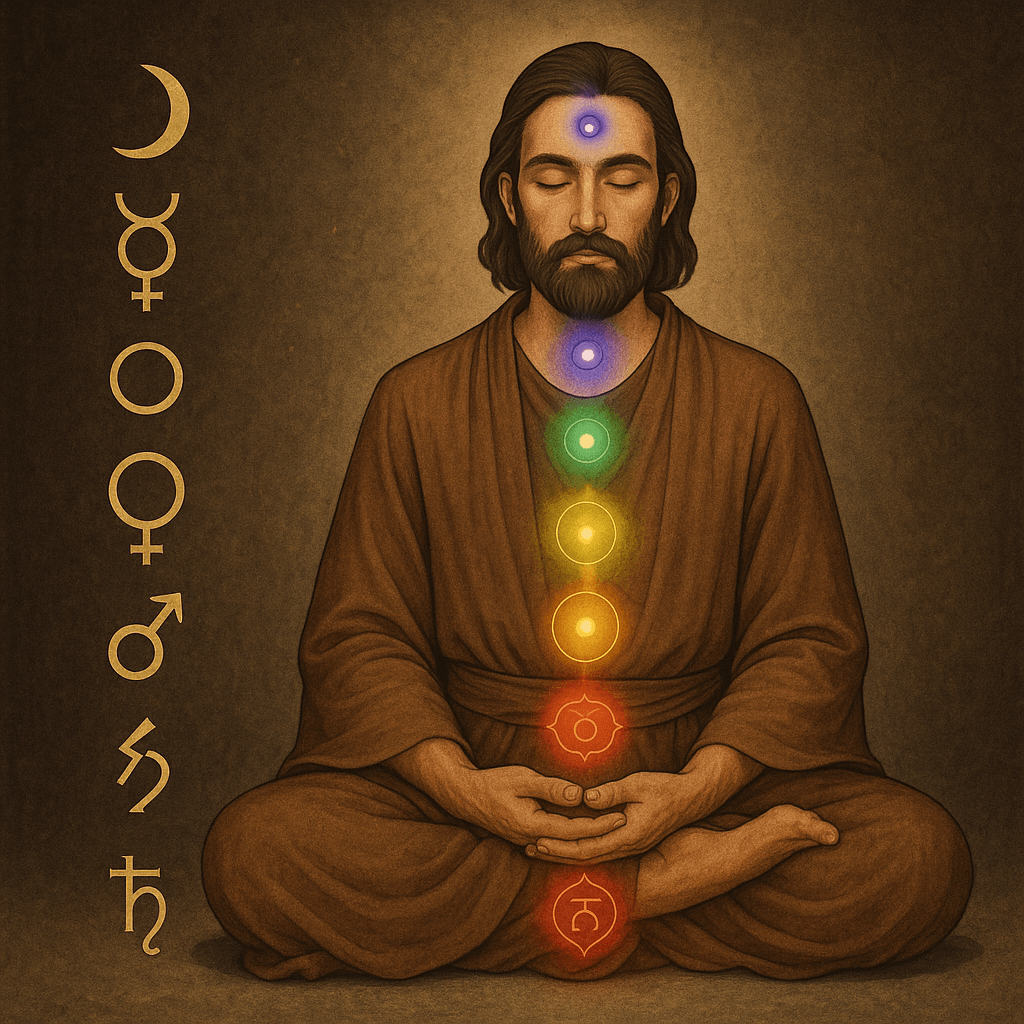
The locations of the familiar seven chakras or psychic wheels of Indian Kundalini yoga serve well as foci for concentration when visualizing the seven seals. These are explained as spiritual nerve centers as such, along the middle channel of three psychic channels down the length of the spine, which branch out into networks of smaller psychic nerves throughout the human anatomy. This is simply a natural place to start.
Such meditations may change substantially if the science makes them inefficient or obsolete. The relative cumulative effects on the brain and quality of life of this construct and alternative constructs should be the subjects of active scientific observation.
Where the chakras are described in the Shiva Samhita, the seventeenth century hatha yoga classic, so are described the three gunas or qualities sattva, rajas and tamas, the forces of harmony, energy and gross matter/inertia. These are identified symbolically with fire, the sun and the moon.
The elixir of immortality is said to flow continuously from the highest chakra, the thousand-petalled Sahasrara at the top of the skull. Every student of Ayurveda, traditional Indian medicine, is familiar with the chakras and the gunas.
Chinese Daoist alchemy basics include a ten-fold and eight-fold scheme, visualizing what are called the microcosmic and macrocosmic orbits. The microcosmic orbit is the visualization of a circuit of ten points encircling the spine from the base up the back to the top of the skull and down the front to return to the base. The macrocosmic orbit consists of eight channels that as a group flow throughout the whole body.
Chinese scholars are intimately familiar with the three-fold scheme in shen (spirit), qi (life-force) and jing (essence). The skeptical scientific internal alchemist may benefit from a knowledge of this three-fold formula. It is the formula of the Chymical Wedding between the macrocosm and microcosm and the production of a new being in their mystical union. In other words, the earthly and the cosmic forces are balanced within the alchemist, producing the self-awareness of the eternal.
The lower elixir field at the base of the spine is the first of three prime centers of concentration in Daoist alchemy. The middle elixir field resides in the solar plexus and the upper elixir field is the “Third Eye” between and slightly above the eyes. Life-force is cultivated within and circulated between these locations with progressive visualizations.
In the lower elixir field a chemical burner purifies life essence (jing); in the middle elixir field the risen chemical burner purifies and combines life essence and life-force (qi); and in the upper elixir field the risen chemical burner purifies and unites life essence, life-force, and spirit (shen).
When Chinese alchemists practice the visualization of bodily circulation of three kinds of energy, they are experimenting with the equivalents of the sun, moon and mercury in Western alchemy. To fit the Chinese Daoist scheme, Luna is salt/essence (jing) in Nigredo, Mercury is quicksilver/life-force (qi) in Albedo, and Sol is sulfur/spirit (shen) in Rubedo.
The Seven Seals: Gods, Planets & Metals
The symbolism and process of inner alchemy is simple to understand and easy to learn. Inner alchemy uses the materials, equipment and processes of chemistry in an allegorical sense, as metaphors for a sacred discipline. Early alchemical writings utilized an ancient seven-fold metal or planetary scheme to describe the process of the mystical ascent. Technical chemistry and metallurgy developed by the Egyptians were merged with Egyptian and Chaldean astrological and magical ideas to produce the relation of the seven planets with the seven metals.
Before the planets were just symbols of the gods, they were for the ancients the visible bodies of the gods in the heavens, and were invoked as such in ritual. Each god/planet/metal was prehistorically represented by a specific symbol and seal. Alchemically, Saturn was the primal matter, the process of putrefaction, which began the process of transmutation, the Great Work.
This Great Work ended in the production of true Gold, represented by the Sun, twin symbols of mystical enlightenment or illumination. The Sun was recognized as the central or primary aspect and was represented by the figure of the point within the circle. The most ancient Chinese symbol for the sun is also the point within the circle. This final seal has fittingly always been known since the dawn of history in both East and West.
Certainly the Candidate begins as Lead and rises through the offices to become the Gold of the Worshipful Master. Gold is associated with Sol, the sun, which is appropriate for the Worshipful Master, but he may also be correlated with Jupiter, the father and ruler god. The symbolism is imperfect because the associations are convoluted, but no other arrangement proves superior.
The contemporary alchemist is invited to experiment with lists of symbols and their correspondences, including the officers of the Royal Art Society ritual. The best system aims for simplicity and clarity, and it improves with constant refinement.
Medical science may hold a more sophisticated view, but until it develops a more effective alchemical method, the modern alchemist may view the gods/planets/metals, or seven seals, as the basic principles of human nature and the primary archetypes of the human subconscious mind. This is a compass rose and map of the psyche that resides in the skull of the Illumined Homo sapiens alchemist.
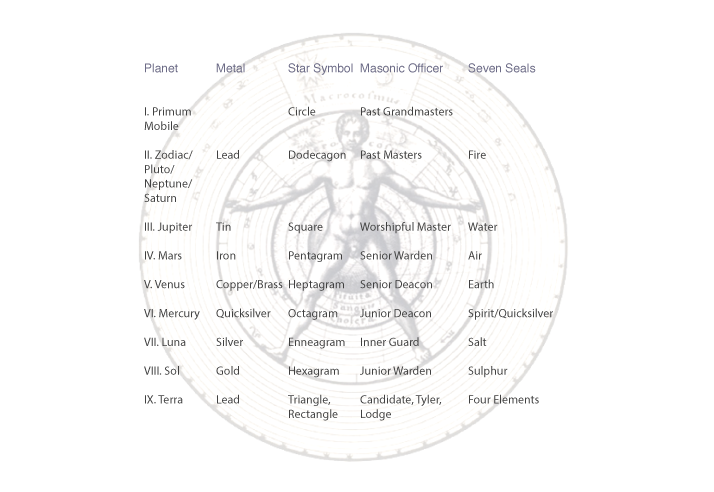
Below, the seven seals are shown with the loose and perhaps ultimately meaningless correspondences from the old and revered astrological, alchemical, magical and Masonic traditions.
The Traditional Alchemical Planetary Scheme and Correspondences
| Planet / Sphere | Metal | Star Symbol | Masonic Officer | Seven Seals |
|---|---|---|---|---|
| I. Primum Mobile | — | Circle | (Past) Grandmasters | — |
| II. Zodiac, Pluto, Neptune, Saturn | Lead | Dodecagon | Past Masters | Fire |
| III. Jupiter | Tin | Square | Worshipful Master | Water |
| IV. Mars | Iron | Pentagram | Senior Warden | Air |
| V. Venus | Copper / Brass | Heptagram | Senior Deacon | Earth |
| VI. Mercury | Quicksilver | Octagram | Junior Deacon | Spirit and Quicksilver |
| VII. Luna (Moon) | Silver | Enneagram | Inner Guard | Salt |
| VIII. Sol (Sun) | Gold | Hexagram | Junior Warden | Sulfur |
| IX. Terra (Earth) | Lead | Triangle / Rectangle | Candidate, Tyler, Lodge | Four Elements |
The Traditional Alchemical Planetary Scheme and Correspondences Chart
NOTES
[1] Peter Atkins, On Being, A Scientist’s Exploration of the Great Questions of Existence, Oxford University Press, 2011.
[2] Carl Sagan, Cosmos, Ballantine Books, New York, Toronto, 1985, p. 42.
The Candidate is required to study the material of the Syllabus I:
Royal Art Society Candidate Grade Nothing, Curriculum Syllabus I
The next ritual marks the transition from the Candidate, the Grade of Nothing, to the Apprentice Alchemist, the Grade of Earth. It is called the Rite of Formation.
The Apprentice – Grade of Earth:
Rite of Formation